Author: Seun

  • The Road to Nowhere: How a Stalled Project Left Enugu Community in Limbo

    The Road to Nowhere: How a Stalled Project Left Enugu Community in Limbo

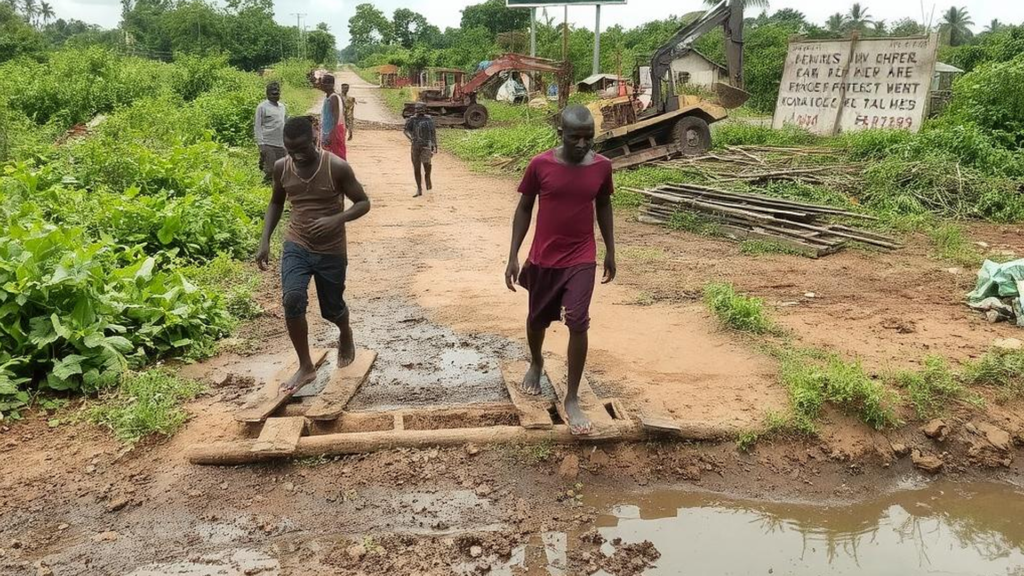
    The Federal Government’s abandonment of a multi-billion-naira road project in Enugu State has taken a serious toll on agriculture and maternal health in Ugwueme. Residents endure hazardous travel conditions to reach healthcare facilities, putting pregnant women, especially at risk. Although a contract was awarded to IDC Construction Limited in 2017, construction has stalled, leaving the community frustrated and vulnerable.

    By Arinze Chijioke

    In a remote part of Enugu State, Nigeria, Peace Okonkwo braced herself for the familiar bumpy journey to her antenatal clinic in Awgu town. Though Ugwueme, her village, has a primary healthcare centre, it lacks a doctor to attend to complex cases like her pregnancy. The nearest well-equipped facilities are a few kilometres away, requiring a trip over treacherous, unpaved roads that residents describe as “a nightmare.”

    On that August morning, Okonkwo joined others on a bus bound for Awgu, but it wasn’t long before their vehicle got stuck in the mud, halting their journey. After an hour of passengers pushing the vehicle, it finally came loose, but the incident underscored a harsh reality: even routine trips to the doctor can become an ordeal. 

    “We spent over an hour trying to pull the bus out,” Okonkwo recalls, adding that her journey was “always filled with bumps, stops, and discomfort.” For years, Ugwueme’s residents have had no choice but to brave these challenging roads, especially women like Okonkwo who face repeated delays and exhaustion when trying to access healthcare.

    Yet this story is not just about poor roads; it’s about a community held hostage by broken promises. In 2017, the Federal Ministry of Works awarded a N14.6 billion contract to IDC Construction Limited to connect Ugwueme and surrounding communities in what was intended as a life-changing project, Theinvestigator probe revealed. 

    The 36-kilometer road, spanning Ugwueme, Nenwenta, Nkwe Ezere, Awgunta Obeagu, Mgbidi, and Nmaku, was supposed to end years of isolation for these communities. For the residents of Anike land, this multi-billion-naira project represented a promise of smoother journeys, better access to healthcare, and, ultimately, a brighter future.

    However, residents are still waiting years later, as the project remains largely abandoned.

    The Broken Promise

    Initially, the news of the road construction had brought hope and excitement to Ugwueme. Many residents, like President-General of Agulese, Sunday Okafor, believed it would finally mark the end of their community’s longstanding struggle with poor infrastructure. But as the years rolled by, hope faded. Residents began to wonder if they had been forgotten again.

    According to Frederick Okeke, a local leader in Ugwueme, IDC Construction arrived shortly after the contract was awarded in 2017. The contractors conducted a survey, raising community expectations that construction would soon begin. However, the work started from the opposite end, in Nmaku, and only progressed eight kilometres before abruptly stopping at Obeagu. Okeke and other community leaders say that was the last they saw of the company.

    Blame And Broken Roads

    When asked why the project stopped, IDC Construction claimed that the Ugwueme community had demanded compensation for crops and buildings along the road. This, they explained, led the government to reroute the project to avoid inhabited areas, opting to build in areas without homes or farmland to bypass compensation.

    However, the residents tell Theinvestigator a different story. “At no point did the community insist on compensation,” Okeke said. According to him, federal surveyors had visited and informed residents that they might receive compensation, but no demands were made. Okeke said the community had even marked their buildings with “Not Affected” inscriptions to reassure the government that they would not hinder the project. Their primary goal, he said, was to see the road built.

    Without this essential road, residents must often trek long distances to avoid the most impassable stretches or detours through neighbouring Isuochi in Abia State, a risky endeavour on poorly maintained motorcycles. In the rainy season, travellers endure slippery, muddy roads, and during the dry season, the terrain becomes a maze of potholes and deep cracks. 

    Many residents, like Okorie Chioma, describe coming back from these trips as exhausting, sore, and in need of pain relievers to cope with the physical strain.

    A Community In Decline

    The incomplete road project has impacted every aspect of life in Ugwueme, from healthcare to business to education. Many local women report missing medical appointments because of travel difficulties. Okorie Chioma, a resident, recalls returning from the market with bags of food, only for her car to get stuck on the road. When she finally made it home, her husband was outside, worried about her delayed return. “It took us hours because we had to keep stopping to avoid bad spots,” she remembers. “When I got back, I was too sore to sleep,” she added.

    Travel costs have soared as motorcyclists, the primary mode of transportation, charge high fees to navigate the rough terrain. What would be a brief drive on a good road now takes time and a steep price. Going from Ugwueme to Awgu town can cost between N2,000 and N2,500 while reaching Newenta costs up to N3,000 — fees that are prohibitive for many.

    Nwabueze Ifeanyi says he has fixed his motorcycle tyres severally.

    But TheInvestigator inquiry shows that the effects of the abandoned road project stretch beyond the immediate inconvenience. Ugwueme and its neighbouring villages, known for their rice, cocoyam, cassava, and palm oil, struggle to move goods to market. Farmers are forced to carry produce on their backs, and perishable goods often spoil before they reach buyers. 

    Many businesses that once operated in the community have shut down, and traders from other communities, like Isuochi, no longer visit. Okafor described this situation as “a terrible economic waste,” noting that perishables are thrown away regularly due to transportation obstacles.

    Women Taking The Lead

    Frustrated with government inaction, the women of Ugwueme decided to take matters into their own hands. Through the Global Ugwueme Women Initiative (GUWI), they began monthly contributions, raising over N50 million since 2019. Their funds have helped make portions of the road temporarily passable, with about one kilometre patched with concrete asphalt.

    “We contribute as low as N200 each,” says Uzoamaka Ogor, GUWI’s spokesperson. “We’ve received support from our daughters abroad and those here at home, and this effort has been ongoing for years. We cannot keep waiting for the government,” she told TheInvestigator. But even Ogor acknowledges that their efforts are unsustainable. Each rainy season, the repaired portions suffer new damage, creating potholes that hinder travel once again.

    The broader community has also pooled resources, raising N1.5 million to grade certain sections of the road. But they know these are only temporary solutions. Without government intervention, they fear the repairs will amount to little more than a band-aid on a wound that needs real healing.

    A Project Stalled

    Since IDC left the project site in 2021, the company claims it cannot return without receiving the N1.3 billion owed by the federal government. According to Okeke Anderson, spokesperson for IDC, their hands are tied. “We cannot return to the site without money,” he said, noting that the cost of materials and labor has surged since the contract was signed. “Back then, a layer of asphalt cost N3,700 per square meter. Today, it costs over N30,000. Without an updated contract to reflect these costs, no work can continue.”

    The contract for the 36-kilometre road project was awarded at N14.6 billion. GovSpend data reveals that between December 2018 and September 2024, IDC Construction Ltd received 10 payments totalling N2.5 billion for the project. 

    In August 2023, Works Minister David Umahi visited the project site, giving residents hope that action might finally follow. He promised that funding issues would be addressed and urged contractors to return to work. “The availability of funds will not be a challenge,” he assured the community. “I will ensure the money is paid,” he reiterated.

    But a further probe by TheInvestigator shows that as of November, no funds have been released, and the project remains dormant. A civil engineer with the Federal Ministry of Works, who spoke anonymously, echoed the financial concerns. He pointed out that contract rates are outdated, making it impossible for IDC to resume work under the current terms. “You can’t expect a company to work at a loss,” he said, adding that the government’s slow funding is a recurring issue for infrastructure projects in Nigeria.

    Hope, Deferred

    Ugwueme’s road remains a striking example of the impact of stalled infrastructure on rural communities. The people of Anike land have waited for decades for this road, believing that it would bring transformation and hope. For now, though, that hope remains just out of reach, another promise unfulfilled.

    As the dry season approaches, the residents brace themselves for another round of temporary fixes. The women of GUWI plan to hire a bulldozer to grade the road and make it somewhat passable. But they are fully aware that these fixes are temporary. “It’s not sustainable,” Ogor admits. Adding that “This road needs proper construction.”

  • Mobility at a Standstill: The Struggle For Kano’s Disabled, Amid Rising Tricycle Costs

    Mobility at a Standstill: The Struggle For Kano’s Disabled, Amid Rising Tricycle Costs

    The rising cost of Persons With Disabilities (PWD) tricycles in Kano State has forced many disabled children to drop out of school, because of the inability to afford the crucial mobility aid needed to continue their education

    Stallion Times reporter, Stephen Enoch explores this crisis in-depth, focusing on one of Kano’s oldest tricycle manufacturing mini-factories, now on the brink of collapse, and how its potential shutdown could severely impact the disabled community without urgent intervention.

    Zaliha Ahmed’s dream of becoming a doctor was as bright as the sun over Dan Amale, a small village in Rimin Gado Local Government Area (LGA), 53 kilometers from Kano.

    Born into a family of seven children, Zaliha stood out, not only because she was the firstborn but also because of her kind heart and deep sense of responsibility for her younger siblings.

    Her parents, recognizing this potential, sent Zaliha to live with her aunt in Kano’s Brigade suburb in Nassarawa LGA, hoping that she could receive a better education and fulfill her dream of becoming the village’s first medical doctor.

    But Zaliha’s journey has been a difficult one. She is among the many children in Kano who were affected by polio, leaving her physically disabled. Determined to give her every chance to succeed, Zaliha was enrolled in Brigade Primary School under the care of Habiba Usman, her aunt.

    She excelled in school, with a sharp mind quickly mastering subjects, but as she reached the end of her primary education, the young lad’s hopes of continuing to secondary school were dashed.

    “I want to go to school, but the lack of a tricycle for people like me has made life unbearable,” Zaliha said, her voice shaking with frustration. Zaliha’s disability means she cannot walk, and for years,  64-year-old Habiba carried her to and from school. But as Habiba has grown older, the physical strain of carrying Zaliha has become too much.

    Now feeble and frail, Habiba can no longer provide this support, leaving Zaliha trapped at home.

    “The one thing that could change my fate is a PWD tricycle, a mobility aid designed to give people like me the independence I need to navigate. But the cost of such a tricycle is far beyond what my family can afford.

    “The tricycle is just too expensive, without it, I can’t go to school. My aunt has tried everything she can, but nothing has worked,” Zaliha said, as tears rolled down her cheek and dropped on her Yellow Hijab.

    This simple equipment stands as a barrier between Zaliha and her education. Like many other physically challenged children in Kano, Zaliha says her future hangs in the balance due to the high cost of these tricycles.

    Zaliha Ahmed PC: Stephen Enoch

    Back in Dan Amale, Zaliha’s days are now marked by sorrow and frustration. She spends her time watching her younger siblings go to school, her once vibrant spirit dimmed by the weight of her circumstances. “Every day, when I see my younger siblings going to school, I feel so sad because I used to be a student too,” Zaliha said, her voice barely audible through her tears. “Now I’m forced to drop out.”

    The emotional weight of Zaliha’s situation has also drawn the attention of her relatives. Recently, some have suggested that the best course for her is marriage.

    “They think I should just get married and settle down since I can’t go to school anymore,” Zaliha said, her voice breaking as tears welled in her eyes. “But I don’t want that. I want to go to school, get a good education, and maybe become a doctor, a nurse, or work in the medical field.”

    She shared her story, and the depth of frustration and sadness was palpable. Sitting on the red, sandy floor, Zaliha crawled toward the shade where she could speak more comfortably. Every movement sent up puffs of dust that clung to her knees. 

    I have heard of many empowerment programs for people like me but none have reached me, even though people have collected my details and promised I would get help.”

    Habiba, Zaliha’s aunt, sat on a worn-out stool in front of her frying pan, along the roadside when she spoke to this reporter, her frail hands clasped together as she spoke of her niece’s struggles.

    Her voice, heavy with years of worry and exhaustion, broke as she recounted the years of care she had provided for Zaliha, her disabled niece who had been left without the one tool that could secure her future—a PWD tricycle.

    “Zaliha is a bright girl with bigger dreams than our village. But I am old and I cannot keep carrying her to school. It has become too much for me.”

    Habiba Usman, Zaliha’s Aunt PC: Stephen Enoch

    As Habiba aged, she knew Zaliha’s dependence on her would only grow if something was not done. About three years ago, realizing her strength was fading, she reached out to a local craftsman, Malam Aminu Tudunwada, who owns the oldest PWD tricycle manufacturing mini-factory in Kano, along Katsina road.

    Malam Aminu was known for creating affordable tricycles for people with disabilities, and Habiba hoped that Aminu would solve Zaliha’s pressing needs.

    “I went to Malam Aminu, pleading with him for a solution, I had hoped he could help us because I knew I was getting too old and feeble. I wanted to ensure Zaliha could continue her education, to be the independent she deserves.

    “Even after three years of waiting, nothing has changed. I have been looking to that mini-factory, praying that they could help provide a tricycle for Zaliha. Her future is slipping away, and I feel powerless.”

    The helplessness in Habiba’s words revealed the deep emotional toll this journey had taken on her. For three long years, she had hoped and waited, watching her niece’s potential wither as her physical limitations kept her from pursuing her dreams. “Zaliha is a good girl, and she deserves better than this,” Habiba said.

    Crisis Hits Kano’s PWD Tricycle Mini-Factory, Leaving Disabled Community in Limbo

    Malam Aminu Tudunwada, a craftsman who operates the oldest PWD tricycle manufacturing mini-factory in Kano, is all too familiar with stories like Zaliha’s.

    Since 1980, Malam Aminu has dedicated his life to making tricycles for people with disabilities (PWDs) at affordable prices. Having experienced the same hardships as a disabled person himself, he understands the impact of mobility on education and independence.

    He narrates his story to Stallion Times: “I also dropped out of school because I didn’t have a tricycle to aid my mobility. I became a burden, and no one could take me to school,” 

    “That was 44 years ago, and my aim has always been to manufacture tricycles for PWDs at a much more affordable cost,” he recounted.

    However, despite his best efforts, the rising cost of materials has put immense pressure on his factory. What used to be sold at around N45,000 now costs at least N90,000 for a basic tricycle.

    “We try to make them affordable because we know how hard life is for PWDs, but many, especially those who need it critically for education, cannot afford even that. Some of the more advanced tricycles can cost as much as N150,000, placing them far out of reach for families like Zaliha’s.

    The impact of these rising costs is evident. While over 93 tricycles sit in his factory, ready for sale, the demand has significantly dropped.

    A section of Aminu’s factory where tricycles are lying for sale PC: Stephen Enoch

    Unlike before, when the factory was bustling with activity, many workers have left because the income they take home is too little. We used to have about 60 workers, but now we can barely boast of 28, and the numbers are dropping day by day.”

    The challenges facing Malam Aminu’s factory go beyond just material costs. Operating the mini-factory in open air, with no permanent structure, has exposed his business to the elements.

    According to Mallam Aminu, he has appealed to the Kano State government for land to establish a proper factory, but his pleas have gone unanswered. 

    “We’ve written several letters upon letters, but we never got a positive response. If we had a fully-fledged factory, we could produce more affordable tricycles for the disabled community, especially children like Zaliha,” he said.

    Despite these obstacles, Malam Aminu has continued to train PWDs in tricycle manufacturing, free of charge, helping them establish workshops in states like Zamfara, Sokoto, Niger, and even in the Niger Republic.

    Malam Aminu Tudun Wada, tricyle enterpreneur PC: Stephen Enoch

    However, his mini-factory is on the verge of collapse. “If things were better, we would have raised funds to assist Zaliha so she could continue her education,” he lamented, “but as things are, we cannot.”

    Malam Aminu called for urgent government and private sector intervention, not only in providing land but also in offering loans and empowerment schemes to help sustain his business.

    “Sometimes we see the government buying PWD tricycles elsewhere, but if they bought from us, it would be much cheaper, and it would improve our business and the livelihoods of PWDs,” he said.

    He pointed out that as his factory faces tough times, so too does the hope for children like Zaliha, whose future hangs on the availability of the tools they need to thrive in school.

    More Gloomy Tales

    The workers at Malam Aminu Tudunwada’s PWD tricycle manufacturing factory in Kano are facing dire circumstances as the factory struggles to stay afloat.

    Abdulmumin Mohammed, who works in the painting section, has seen many of his colleagues leave because of the dwindling patronage and the impact of rising inflation.

    “A small tin of paint that used to sell for N4,000 now costs N15,000. It’s become so expensive that I don’t come to work every day anymore—only when there’s work, and I know I’ll make some money. Otherwise, I have to find other ways to survive.”

    Abdulmumin working in the painting section of the factory PC: Stephen Enoch

    Tin of Paint at the factory PC: Stephen Enoch

    He described how, week after week, workers are forced to quit due to the difficult conditions at the factory. “Just last week, one of my friends left the job,” he said. “A lot of us are grumbling. If things don’t change soon, more people will leave.”

    Auwalu Shuai’bu, another worker in the wheeling section, has also felt the pinch.

    To support his family, he’s had to take on extra work, driving a gasoline tricycle (Keke Napep) to transport passengers when there’s no money to be made at the factory.

    “I can’t survive on what I earn from the workshop anymore,” Auwalu admitted.

    “When I’m not making enough here, I use my Keke Napep to pick up passengers. If there are no passengers, I play para-soccer to earn something.”

    Despite these challenges, Auwalu stays at the factory because of his passion for producing affordable tricycles for people with disabilities (PWDs) in Kano. But the reality is harsh.

     “Things are tough now, PWDs can’t afford these tricycles, which are a necessity. It breaks my heart to see this.”

    Auwalu working in the wheeling section PC: Stephen Enoch

    Both Abdulmumin and Auwalu expressed their urgent plea for government support, echoing the thoughts of his colleagues.

     “If the government could empower me with loans, we could continue making these tricycles affordable for the disabled community. Otherwise, the future of this workshop—and the people we help—looks bleak.”

    The workers’ struggle reflects the larger battle for survival within the factory, which has long been a lifeline for PWDs in Kano but is now on the verge of collapse.

    Stallion Times observes that as Malam Aminu’s factory teeters on the brink of collapse, his once-vital mission of providing affordable mobility for PWDs may soon become a distant memory, leaving many—like Zaliha—trapped in a cycle of unfulfilled potential, unable to access the education that could transform their lives.

    This report was published with the support of Civic Media Lab.