

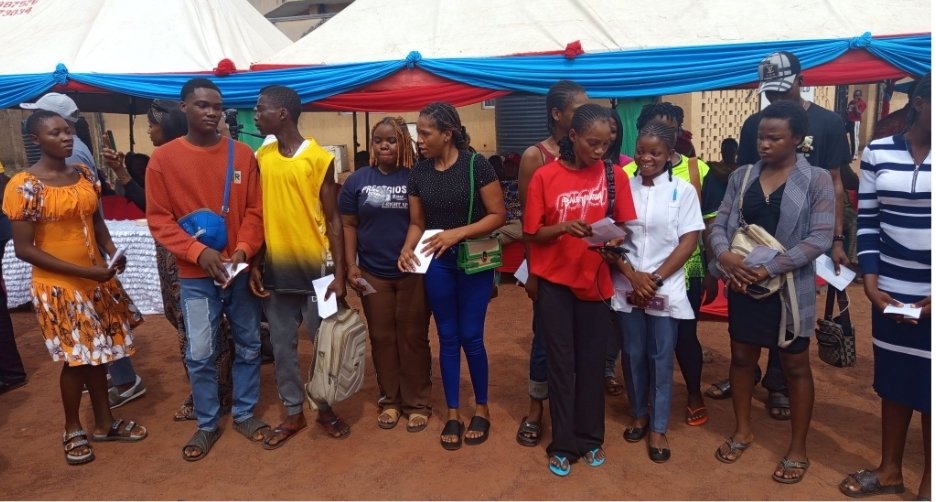
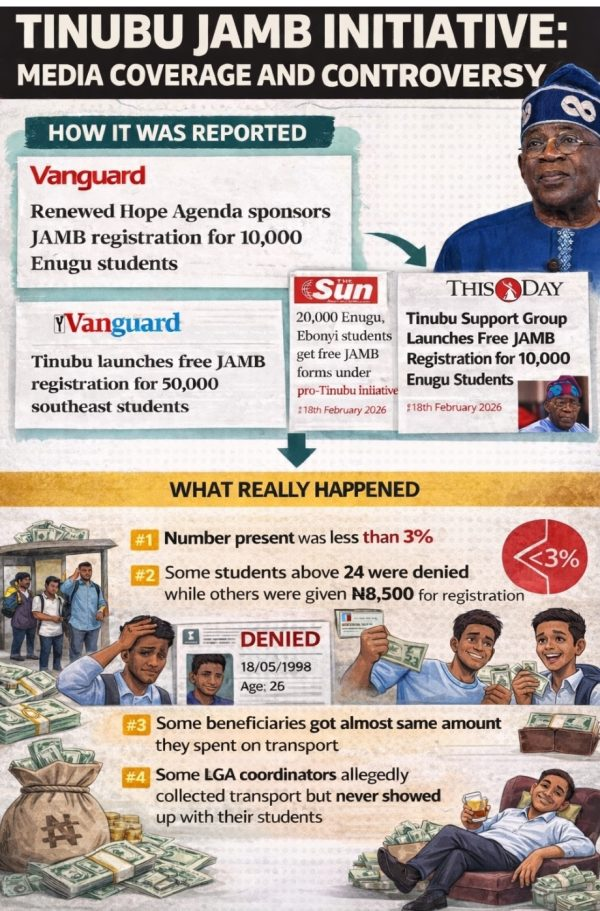
Between February 17 and 18, some national dailies and television stations were awash with reports announcing the launch of a free JAMB registration programme for 50, 000 students by the South East Renewed Hope Agenda (SERHA), with each state expected to produce 10,000 beneficiaries. In this investigation, TheInvestigator’s Arinze Chijioke examines how, in Enugu State, fewer than 3% of the intended beneficiaries turned up and received only ₦8,500 each to facilitate their own registration. The report unpacks how the initiative, widely promoted as a major educational intervention, was instead plagued by gaps in transparency, poor coordination, and inconsistencies between what was promised and what was delivered
An open space at the National Museum, behind New Berries Park in Enugu State, was supposed to be the venue for the free registration of students in the state for this year’s Joint Admissions and Matriculation Board examination on Tuesday, February 17th. The Southeast Renewed Hope Agenda (SEHRA) announced it would provide free JAMB registration for 50,000 students across the Southeast region. According to the group, this was intended to remove financial barriers that prevent many students from writing the examination.
The SEHRA operates as a regional mobilisation platform aligned with the Renewed Hope policy framework and the re-election of Nigeria’s President, Bola Tinubu. While the group does not publicly disclose its finances, its activities, including youth engagement programmes, are framed as supporting the federal Renewed Hope Agenda, which is government-funded.
A day earlier, the secretary of the group in Enugu State, Chris Agu, told students via WhatsApp that the free JAMB registration would be held at the event venue. In another WhatsApp message seen by this reporter, the coordinator of the group for Udenu Local Government Area also told students that “Jamb officials would be present to facilitate immediate UTME registration for participants/beneficiaries from Enugu state”.
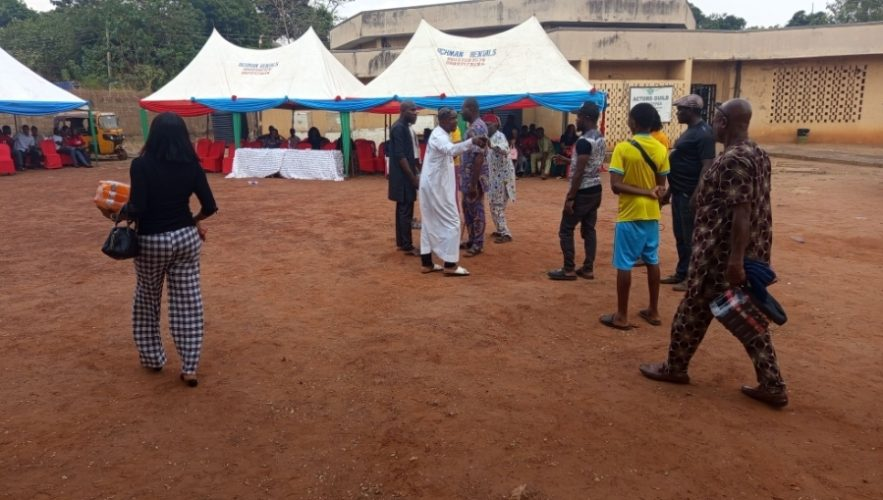
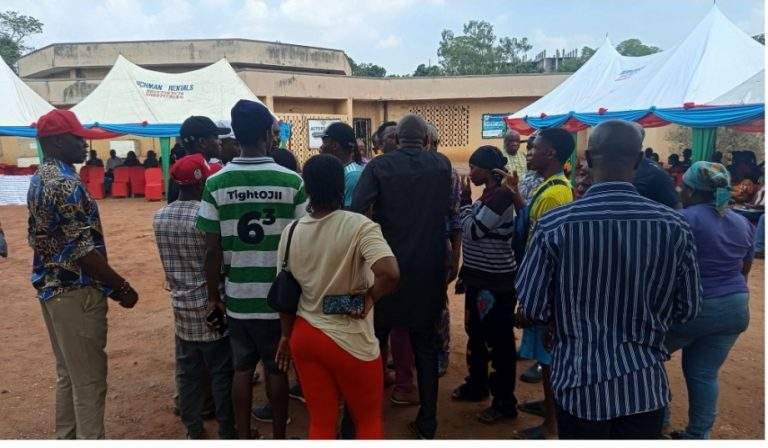
That Tuesday morning, Anthony Chisom, an applicant from Isi Uzo local government, and students from other LGAs hoped to see JAMB officials seated with their laptops, ready to enrol them in the examination, which was ending exactly 11 days later. But upon arrival at the venue, they discovered that no registration was going on. Instead, about 7 canopies were arranged at different locations, with plastic chairs draped in red cloth and music playing in the background.
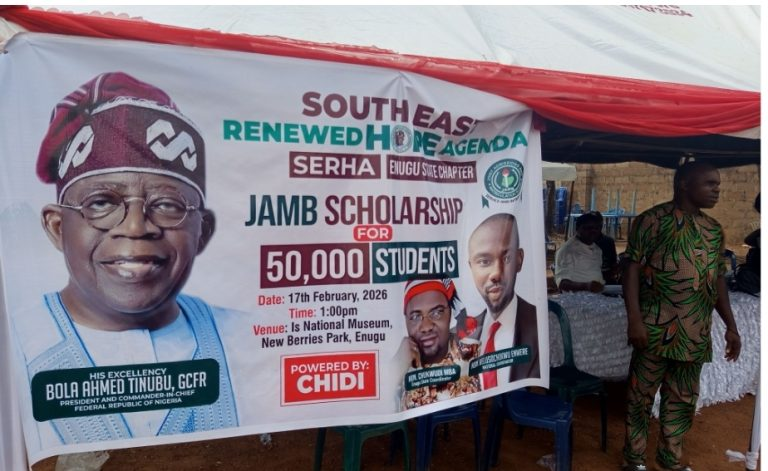
At one end of the location, a banner with an image of President Tinubu, that of SERHA’s National Coordinator, Belusochukwu Enwere, and the state coordinator, Chukwudi Mba, was hanging down with an inscription “South East Renewed Hope Agenda (SERHA) Enugu State Chapter JAMB Scholarship for 50,000 students. Behind the banner, some individuals were seated with forms, confirming the details of students who had provided their names, phone numbers, emails, ages, communities, and LGA during the application phase.
Soon, Enwere got on stage and began to address the students. He described the intervention as a strategic investment in the future of young people in the state. He said that the initiative was designed to remove financial barriers that prevent many brilliant students from sitting for the UTME.
“Today is not just a ceremony. Today is a movement of hope and empowerment that boldly declares that the future of Enugu State will not be limited by financial barriers,” he said. “Many brilliant young minds lose opportunities each year simply because they cannot afford registration fees. That reality must change, and, today, President Bola Tinubu is changing it.” “This programme is not charity; it is strategic empowerment. When we educate our youth, we secure our economy. When we empower our students, we strengthen our nation.”
After his address, the master of the ceremony asked the students to clap, and they obliged. Soon, the students were asked to line up while Enwere, accompanied by other coordinators and an individual carrying a bag, handed out envelopes containing N8,500 to each of them, instead of a proper registration as promised.
“I did not understand what was going on, what we were told was that registration would be done at the venue,” a distraught Chisom said.
The amount was supposed to cover the cost of JAMB registration and the mock exam. Findings show that while the registration alone costs ₦7200, the mock costs ₦1500, for a total of ₦8700.
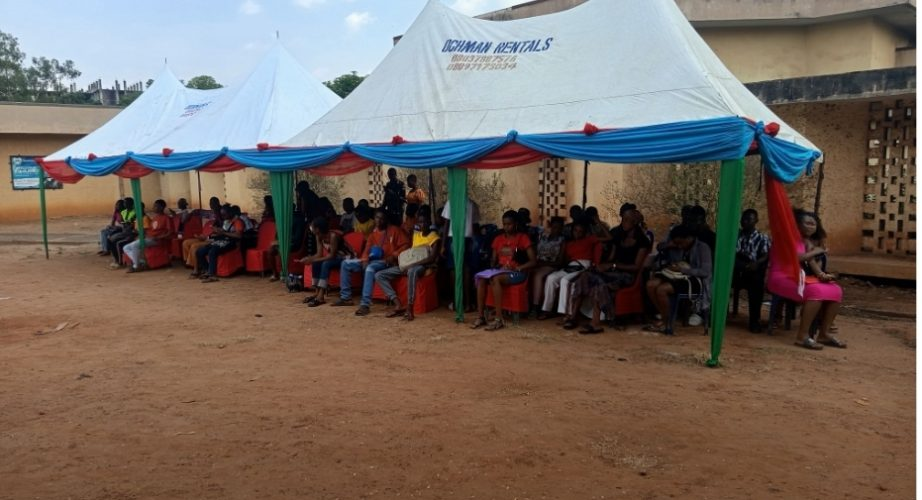
When the distribution ended, the students were asked to raise their envelopes while they praised President Tinubu’s administration. Some attendees were also encouraged to publicly express their support for the President during the ceremony.
One of them, Emeka Udeh, said, “I finished school in August 2021, but I did not have money to further. Fortunately for me today, the president has shown that he can do everything possible for us who do not have the money to further our education. I am grateful to him.”
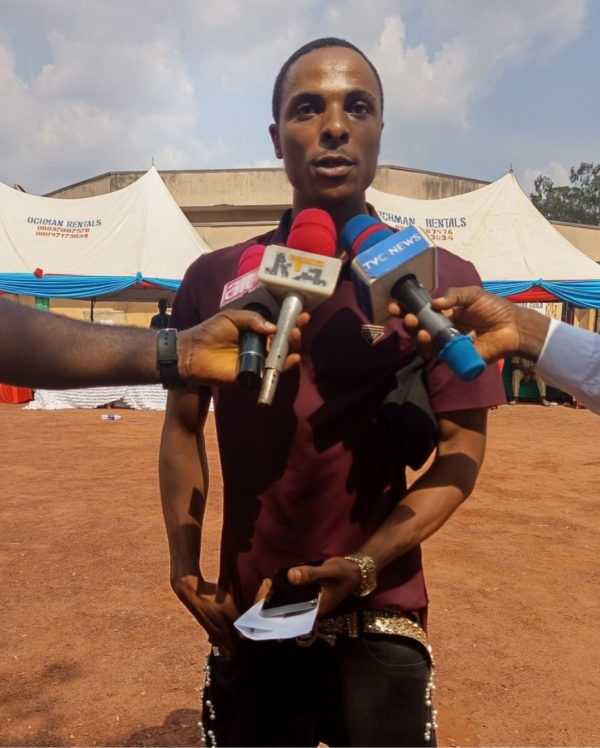
Another beneficiary, Chioma Eneh, said: “I will use the money for the JAMB registration because it would have been difficult to gather the money if I did not get it here. It has become a lot easier for me.”
Soon, Enwere got into a black Jeep and zoomed off with individuals believed to be working closely with him. Thereafter, the students dispersed into groups with their coordinators, while Gala and small bottles of soft drinks were distributed as lunch. It was almost the close of business when the event ended. And because they were not registered at the venue as promised, Chisom slept at a friend’s house and registered the next morning before travelling back.
Before they left, he and other students from his LGA were given ₦1000 to support their transportation, despite having already spent ₦6,000 individually to travel to the venue, almost the entire money received as a scholarship. Students who did not have anywhere to stay travelled back the same day with the money they received.
“In Isi-Uzo, we don’t have anywhere to register for JAMB, except in Enugu, or we travel to Nsukka,” he said. “If they had done the registration without giving us money, it would have been better; now the plan is defeated for some students who spent it on transportation”. They told us it was going to be free registration, but when we came, they started giving us money.
Enugu State Deputy woman leader of the group, Angela Nwabuno, claimed that the JAMB officials did not show up because of the low turnout of students, but one of the leaders of the group, Johson Ejiofor (not real name), told this reporter that they considered the logistics cost of bringing JAMB officials and thought it was more cost-effective to pay the students.
However, this was only one of several issues that undermined the much-publicised free JAMB registration initiative.
How Many People Really Attended?
The free JAMB registration initiative was publicly announced to benefit 50,000 students across the Southeast, with 10,000 beneficiaries allocated to each of the five states in the region. In Enugu State, which has 17 local government areas and 260 wards, each LGA was entitled to 588 candidates and approximately 38 per ward. This would, in theory, ensure broad geographical coverage and equal opportunity for students from both urban and rural communities.
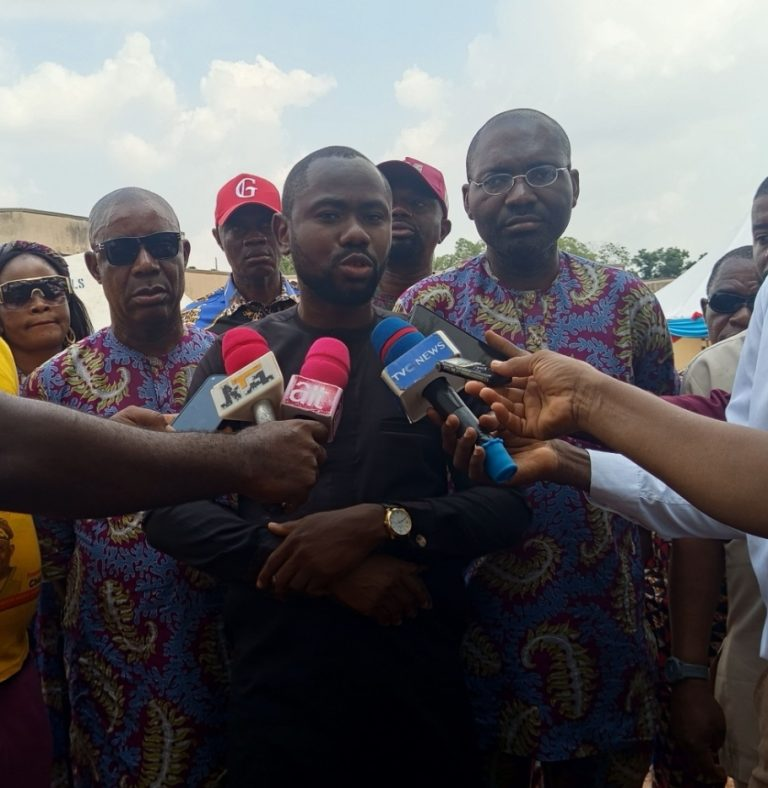
At 10,000 students per state, that amounts to ₦85 million per state, totalling ₦425 million across the five Southeast states. However, attendance at the Enugu flag-off told a different story. Fewer than 3 per cent of the expected 10,000 students were present at the venue. Among the local government areas represented, Isi-Uzo had the highest turnout, with about 25 students. Most other LGAs had fewer than 10 students in attendance, while about four LGAs were completely absent.
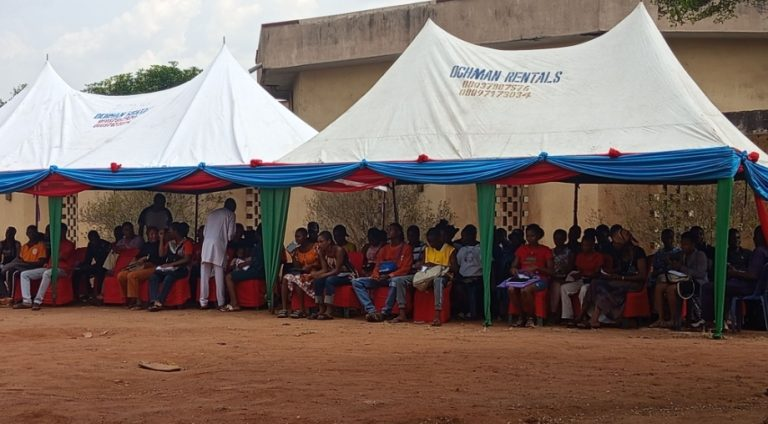
Mr Joseph Chidi, a ward coordinator (not real name), told this reporter that he was only asked to bring one candidate. “The national coordinator has done what he was asked to do, “he said. “They have the money, and that is why they were paying it in cash. But where are the students?”
The gap between the announced figures and actual turnout raises concerns about whether the intervention was carefully designed to prioritise educational access or structured primarily as a high-visibility political event. For many observers, the project was a hard sell, one that clearly prioritised optics and political messaging over measurable impact.
Ejiofor disclosed that the programme lacked transparency because some people were not included or informed about how much was coming in. “If we have details, it becomes easy for us to track. We don’t know what was brought, and we don’t know how to question it. The more you look, the less you see. Some of us tried to raise concerns, but it looked like we had personal interests.”
This reporter reached out to Bar Agu with questions around how students who could not make it to the venue would be reached before the 2026 UTME registration deadline on Saturday, February 28. He said that the coordinators’ account details had already been submitted to the leadership and that funds would soon be made available to them for onward disbursement to students.
“We are still hoping to hear from those at the top. We are patient because it is something that is coming from a high office; it is not only in Enugu State that we have this kind of challenge, “he said.
He told this reporter that the leaders would have a virtual meeting on Tuesday, February 24, to further discuss the matter. However, when contacted again on Thursday, February 26, to ascertain the outcome of the meeting and whether there was clarity on payments, he said there was no update regarding the disbursement of funds.
No Proper Coordination
A major factor contributing to the low turnout was the failure to provide adequate transportation, despite prior assurances. Messages from some local government coordinators indicated that vehicles would be arranged to transport students to the event venue.
However, interviews conducted for this investigation revealed that most students travelled to Enugu on their own. Many of them live outside the Enugu metropolis, making transportation costs a significant barrier. Students from Nsukka reported spending up to ₦7,000 on transport, while some from Udenu said they spent up to ₦8,000.
Ezinne Faith was among 10 students who travelled from Udenu. She initially informed one of the group leaders that she would not attend because she could not afford the fare. She eventually made the trip in his car. Her coordinator told her that the transportation plans had changed because they had calculated and found that they could not afford the round-trip cost. She and other students from her LGA received a ₦4,000 transport refund.
The group’s state secretary gave a different account. He told this reporter that arrangements had indeed been made. According to him, each local government coordinator was given ₦50,000 four days before the event to hire buses to transport students to and from the venue. Explaining the discrepancies, he said that some students do not reside near their local government headquarters, the designated departure points, and that many drivers were unwilling to travel deep into rural communities. He also alleged that some coordinators failed to show up after collecting the funds.
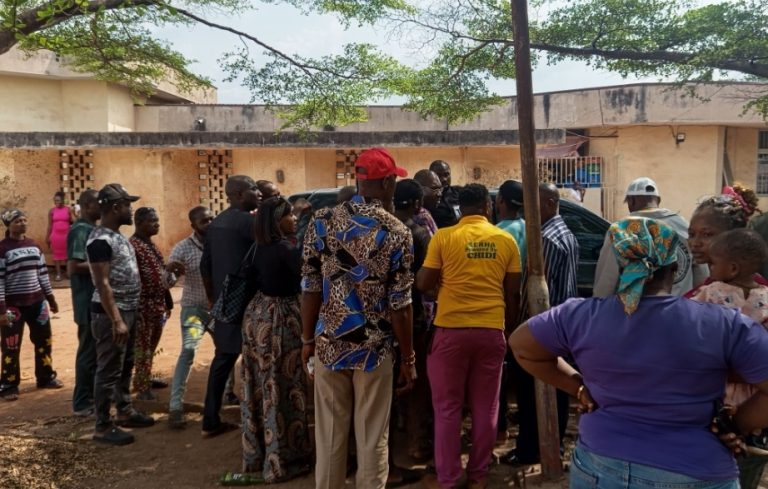
Another leader who confirmed the payment argued that the money was insufficient. He suggested that the limited allocation partly explained why some coordinators did not mobilise students as expected.
Attempting to deflect from allegations of poor planning, the woman leader of the group, Nwabuno, argued that the low turnout was partly due to what she described as the public’s longstanding mistrust of government-backed promises. According to her, many students may have doubted the sincerity of the offer and therefore chose not to participate.
“At first, many people indicated interest, but on the day of the event, we were surprised that Enugu could not provide up to 1,000. Those who reluctantly came ended up being happy because of the promises given to them.”
When asked what happened to the remaining money, Nwabuno said that the national coordinator, Enwere, was in charge and that the programme had ended. “Nobody should bother anyone about missing the date because the leaders were going round the states involved, Enugu State’s own has passed.”
Agu clarified that the program was not strictly for indigenes of Enugu State but for students residing in the state, regardless of origin. This reporter noticed that a student who resides in Imo State and completed her registration there still had her name captured in the group for Enugu State.
You Must Be 24 Or Below
Apart from the transportation, Nwabuno claimed that many candidates were disqualified because of their age. “The age range shouldn’t border on anyone because that is the design of the programme; it is an opportunity to those who are still in that age bracket,” Nwabuno said.
Contrary to Nwabuno’s claims, Ejiofor said that the age restriction was meant to curb alleged attempts by non-students to access the funds, rather than to deny qualified candidates the opportunity to register for the examination.
“Some of them just heard that money was being shared and came around,‘ he said. “But we had others who were beyond 24 but proved that they were sitting for the examination, to those, we gave the money.” I had a candidate over 30 who got the money.
The national coordinator of the SERHA also confirmed this and said that students were asked to provide their National Identity Number to verify their ages before receiving the money.
Many students who paid out of pocket said they did not receive any further information about the process after submitting their details. Some of them said the message came the same day the event was held, and they could not travel. Ugwu Francisca, from Okpatu in Udi Local Government, said she learned about the event that same morning, after travelling to Imo State for a burial. She said that many students from her community did not show up because they were afraid to travel alone.
Ejimofor Ifeanyi is from Ovim in Isiokwuato LGA, Abia state, but resides in Enugu. He said that his contact was not added to the WhatsApp platform where the information was shared after he registered under Enugu North. He lives in the Uwani area of the state and said that he only knew about it from a friend’s post after the event had ended. That same day, he went to register for JAMB.
Ejiofor maintained that the lack of transparency and coordination was a major drawback of the initiative. “The truth remains that If proper arrangement for transportation was made, more students would have come, “he said. “The group had enough money to make proper transportation arrangements.”
He suggested that if the funds were taken to the communities, without having the students come down to Enugu, it would have made more impact. He also said that if they had kept the number at 1000 students and made proper arrangements, it would have been more far-reaching than what happened.
“There was no need to exaggerate the numbers and not achieve the aim, “he said. “It is not difficult to get the numbers because there are different Jamb lesson centres across communities. We could get their names, bring them together in the communities, and share the money, but they were not willing to do that.”
Enwere Disagrees, Insists 10,000 Students Received Payments
When contacted, the national coordinator, Enwere, claimed that although some people were sceptical about the exercise, they still managed to register 10,000 students in Enugu, as in other states in the region. He claimed that he and his team continued making payments even after the launch to students who could not attend the venues.
“The teams assigned the task kept on bringing students’ files, and I was signing, and we were remitting money,” he said. “We went to churches and also used government and private schools to register students.” Those who had registered, we gave them back their money.”
He shared videos and a picture of the distribution to Ahiara Diocesan Students and Seminarians in Imo State, as well as to other students in Onitsha, and promised to provide a comprehensive list of all beneficiaries. This reporter requested videos from other states, particularly in Enugu State. He promised to provide those.
Contrary to what some coordinators told this reporter and what messages seen indicate, Enwere also claimed that it was never agreed that registrations would be held at the venue of the launch. But he confirmed that ₦50,000 was provided as transportation to all the LGA coordinators and said that the collection of names started two weeks before the launch.
This reporter reached out to the State coordinator of the SERHA, Chukwudi Mba, for further confirmation of the exact number of beneficiaries, but he could not provide the number of students from his own records. He also did not mention that the distribution continued after the official launch, as the national coordinator claimed. No other coordinator did.
Mba said, “What matters is that Enugu people were on the ground and benefited from the project; we might not really know the number.” Whoever did not benefit from this program will benefit from others. “You cannot be too sure that they are less than five hundred because appearance could be deceptive.”
Enwere could not provide the list or the other videos at the time of publication.
This report was produced with support from Civic Media Lab.
Editor’s note: Names of some sources have been withheld on their request for fear of victimisation.